AI Publisher
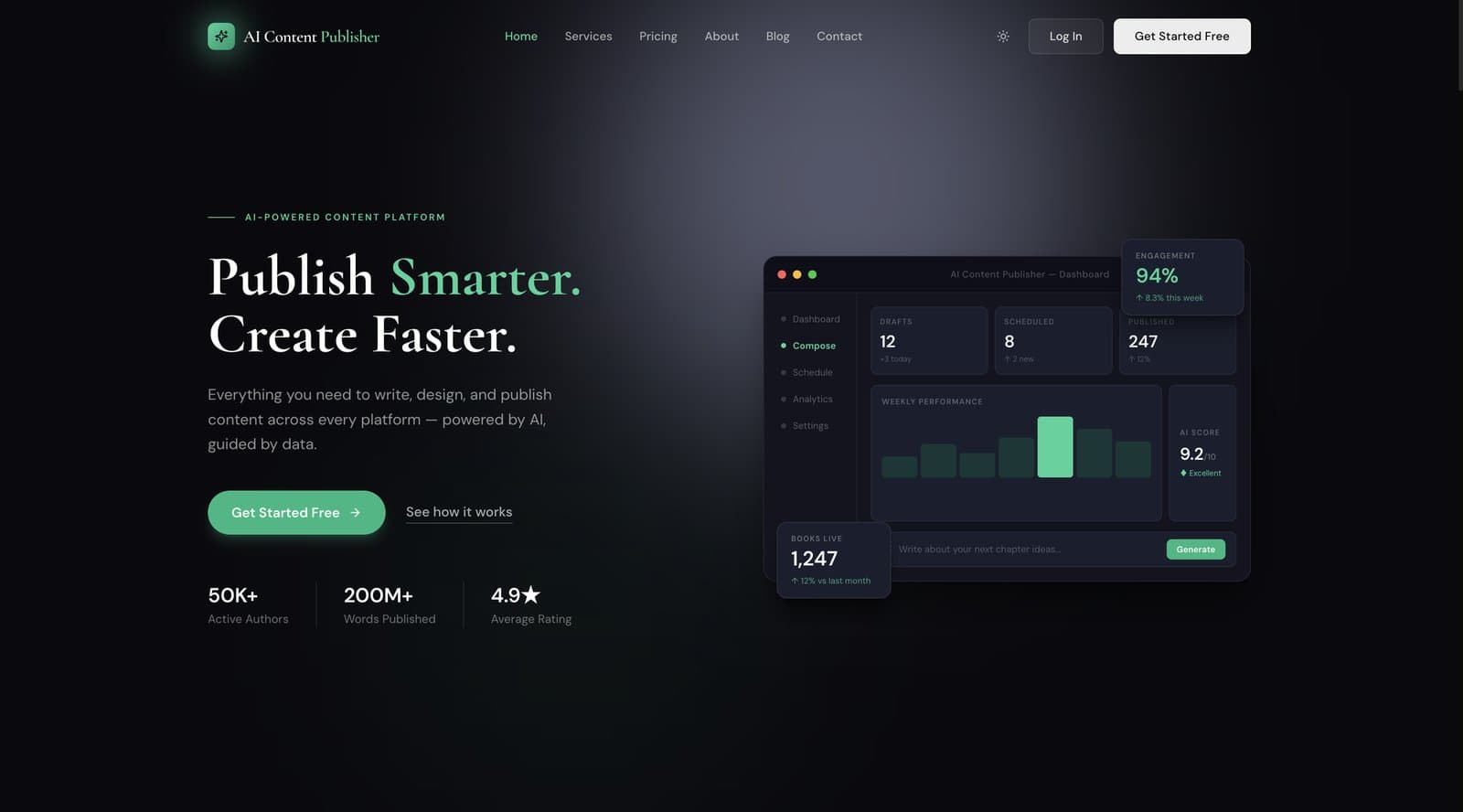
A multi-sided AI SaaS platform that turns book publishing into a guided, AI-assisted product, taking a writer from a first idea to a finished manuscript, cover, and distribution package.
The Problem
Turn a static marketing site into a full publishing platform modeled on premium ghostwriting services, with an AI co-writer at the center, serving three different audiences from one codebase: independent authors writing their first book, agency clients managing a slate of titles for a team, and internal admins reviewing every manuscript before it goes to print.
The Starting Point
An idea and an existing static marketing site, rebuilt from the ground up into a full production SaaS platform over roughly four months, solo.
The Solution
Ten interlocking systems shipped as their own specs and pull requests: an AI writing engine, a manuscript editor, a cover design studio, a layout and publishing pipeline, manuscript import, an admin review workflow, client and agency dashboards, billing, and realtime notifications, all built to work together as one product rather than as ten separate demos.
Architecture
Engineering Work
Row-Level Security on every table, server-side ownership checks on every resource, Zod validation on all external input, and AI/payment calls kept server-only. The process was spec-first: 30 written specs, one branch per feature, PR-reviewed, nothing merged straight to main, with typecheck, lint, unit tests, and a production build required before every merge. Three real production incidents were found and fixed after launch. A retired AI model ID started 404-ing in production and was fixed by moving to a durable alias. A silent token-ledger gap, where usage rows were being rejected by a missing Row-Level-Security insert policy, was fixed by routing writes through the service-role client. A cross-chapter autosave race condition caused by a stale closure was fixed by scoping the save to a captured snapshot. Print-quality PDF rendering is isolated in a Vercel Sandbox rather than the main app process, since it's heavy and sits close to untrusted input.
AI Contribution
Claude powers the writing engine: chapter drafts stream over SSE with live token accounting, metered and rate-limited by plan before every call. Ideogram v2 generates cover concepts, and title typography is overlaid client-side afterward so the AI is never asked to render text directly.
Results
124 commits, 50 merged pull requests, 478 TypeScript source files, 21 database migrations, and 53 unit/E2E test files across a roughly four-month solo build. These are engineering-effort metrics, not business outcome metrics; real usage numbers aren't available yet.
Final Product